|
|
||
| New Lunar Topographic Map is Best Yet A LOLA digital elevation map compiled in late 2009 is compared to the Unified Lunar Control Network (ULCN) 2005, a painstakingly constructed map based on the best available data at the time. |
LRO/LOLA - Counting Craters Using the Lunar Reconnaissance Orbiter’s Lunar Orbiter Laser Altimeter (LOLA), NASA scientists have created the first-ever comprehensive catalog of large craters on the moon. In this animation, lunar craters larger than 20km in diameter “light up” using LOLA elevation data. |
|
|
June 22, 2009 |
|
|
Explanation: This rocket is headed for the Moon. Pictured above, a huge Altas V rocket roared off the launch pad last week to start NASA's first missions to Earth's Moon in 10 years. The rocket is carrying two robotic spacecraft. The Lunar Reconnaissance Orbiter (LRO) is scheduled to orbit and better map the Moon, search for buried and hidden ice, and return many high resolution images. Some images will be below one-meter in resolution and include images of historic Apollo landing sites. Exploratory data and images should allow a more informed choice of possible future astronaut landing sites. The Lunar CRater Observation and Sensing Satellite (LCROSS) is scheduled to monitor the controlled impact of the rocket's upper stage into a permanently shadowed crater near the Moon's south pole. This impact, which should occur in about three months, might be visible on Earth through small telescopes. |
|
  |
|
Robotic Lunar Exploration Home Page
Lunar Reconnaissance Orbiter Overview: The Instrument Suite and Mission
Lunar Reconnaissance Orbiter (LRO) Navigation Overview May 21, 2008
LRO and LCROSS Press Kit, June 2009
Multimedia Gallery Images, video, and animations for LRO and LCROSS can be found at: LRO:
http://svs.gsfc.nasa.gov/Gallery/LunarReconnaissanceOrbiter.html LCROSS -- from press kit, appears to be busted link.
http://www.nasa.gov/mission_pages/LCROSS/multimedia/index.html
The Lunar Reconnaissance Orbiter Laser Ranging Investigation, Space Science Reviews, 2009
Abstract: The objective of the Lunar Reconnaissance Orbiter (LRO) Laser Ranging (LR) system is to collect precise measurements of range that allow the spacecraft to achieve its requirement for precision orbit determination. The LR will make one-way range measurements via laser pulse time-of-flight from Earth to LRO, and will determine the position of the spacecraft at a sub-meter level with respect to ground stations on Earth and the center of mass of the Moon. Ranging will occur whenever LRO is visible in the line of sight from participating Earth ground tracking stations. The LR consists of two primary components, a flight system and ground system. The flight system consists of a small receiver telescope mounted on the LRO high-gain antenna that captures the uplinked laser signal, and a fiber optic cable that routes the signal to the Lunar Orbiter Laser Altimeter (LOLA) instrument on LRO. The LOLA instrument receiver records the time of the laser signal based on an ultrastable crystal oscillator, and provides the information to the onboard LRO data system for storage and/or transmittal to the ground through the spacecraft radio frequency link. The LR ground system consists of network of satellite laser ranging stations, a data reception and distribution facility, and the LOLA Science Operations Center. LR measurements will enable the determination of a threedimensional geodetic grid for the Moon based on the precise seleno-location of ground spots from LOLA.
Apollo Laser Altimeters
Final Report: Apollo Laser Altimeter Analysis, S-216: William L. Sjogren, Principal Investigator, JPL. January, 1975
Two LOLA Seminars: (note: add DASC 2008 presentations/papers)
"Engineering Aspects of the Lunar Orbiter Laser Altimeter (LOLA) Digital Unit Design" - (October 17, 2007)
"Back to the Moon: The Verification of a Small Microprocessor's Logic Design" - (September 19, 2007)
- Presentation: Back to the Moon
- Paper (presented at 2008 DASC): (.doc) -- (.pdf)
September 21, 2009:
LRO BEGINS DETAILED MAPPING OF MOON’S SOUTH POLE: NASA reported on September 17 that its Lunar Reconnaissance Orbiter (LRO) has successfully completed its testing and calibration phase and entered its mapping orbit of the Moon. Scientists released preliminary images and data from LRO’s seven instruments. LRO is scheduled for a one-year exploration mission in a polar orbit of about 31 miles above the lunar surface, the closest any spacecraft has orbited the Moon. During the next year, LRO will produce a complete map of the lunar surface in unprecedented detail, search for resources and safe landing sites for human explorers, and measure lunar temperatures and radiation levels. For more information about LRO and to view the new images, visit: http://www.nasa.gov/lro.
Size:
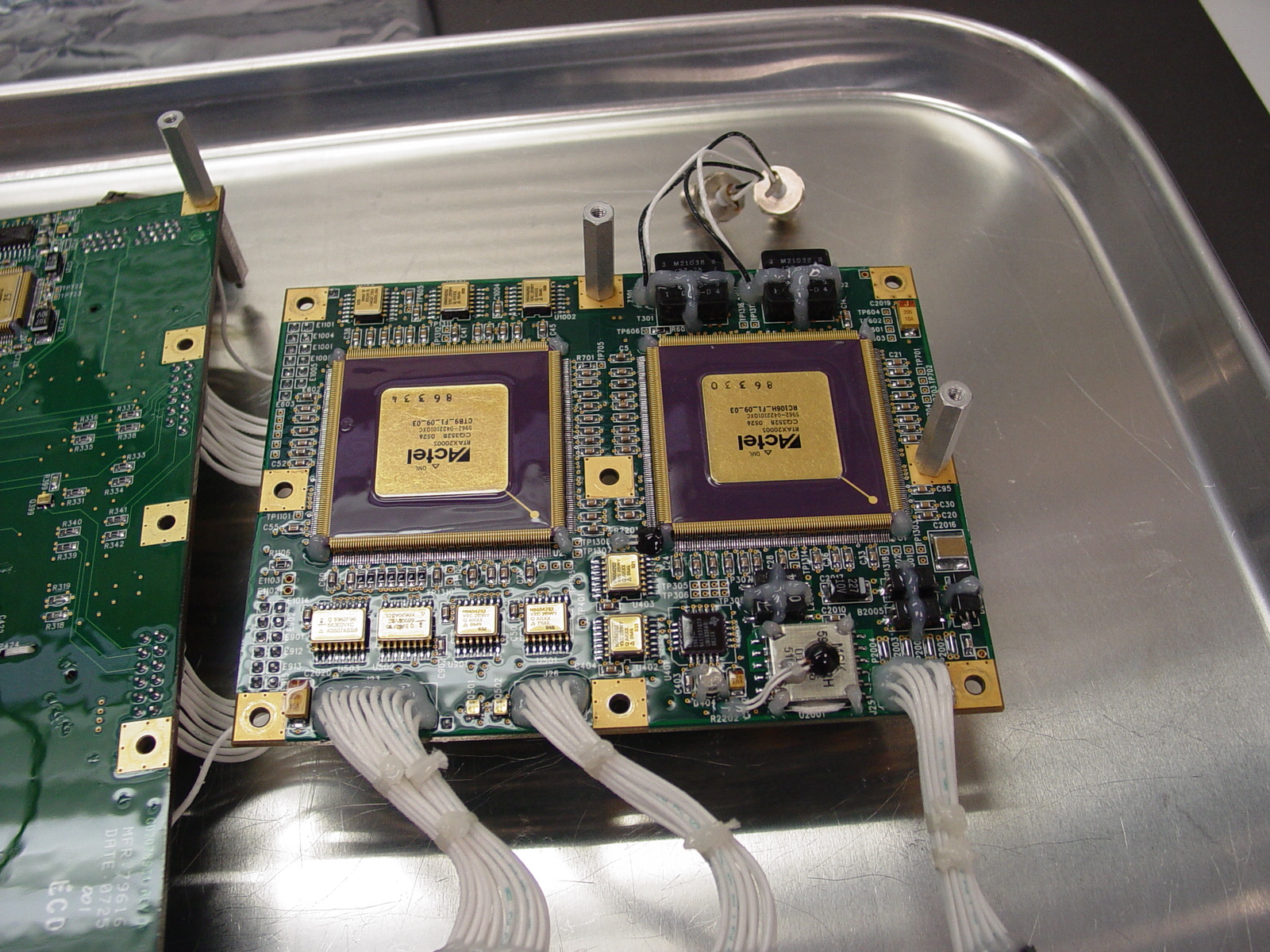
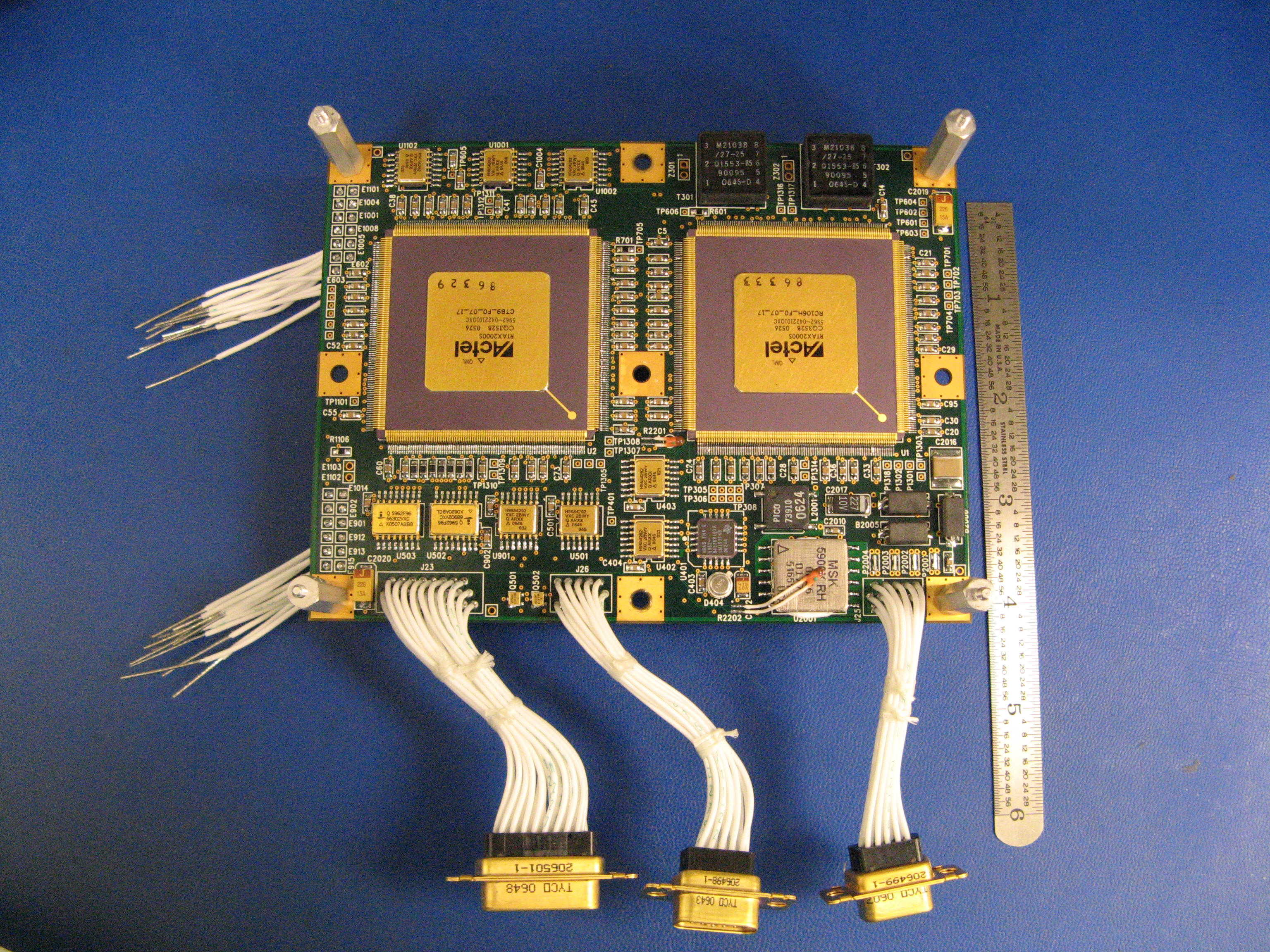
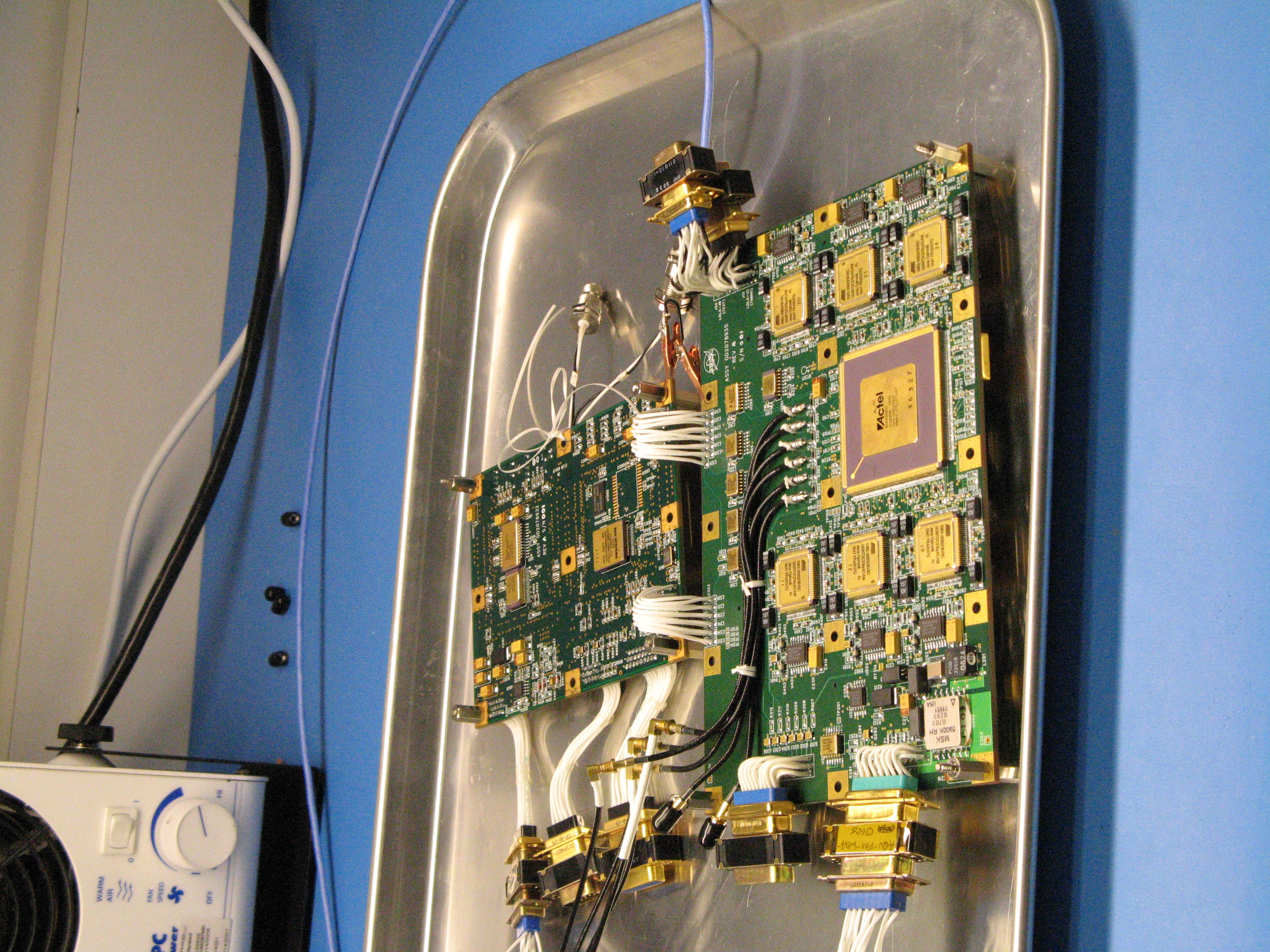
C&T Board: 4" x 6" (Command and Telemetry)
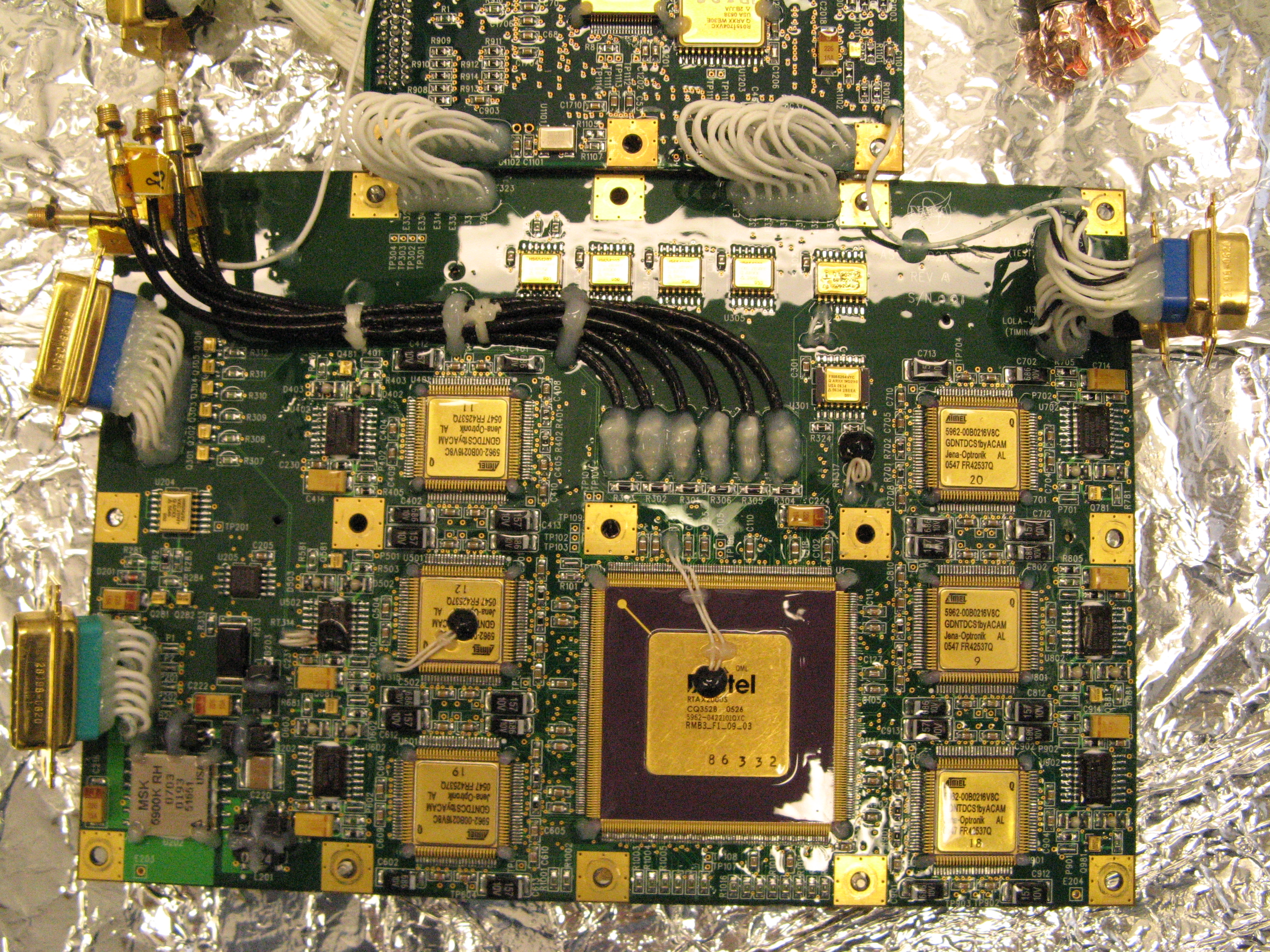
RMU Board: 6" x 8" (Range Measurement Unit)
Mass:
without (staking and conformal coat): 613 grams
with staking and conformal coat: 628 grams
Power:
In flight the 1.5V supply (for the FPGA's core) is derived from the 3.3V supply via a low voltage dropout regulator.
The +5V supply is used for the MIL-STD-1553B transceiver.
The +12V supply is used for the TDC-S1 microcircuits; a significantly lower supply could be used to save power. +12V was an available system voltage.
Current (mA)
12V 5V 3.3V and 1.5V
(combined)3.3V 1.5V +60 °C 463 40 640 +25 °C 408 38 464 225 236 -30 °C 342 35 438
Data from March 18-19, 2008 Thermal/Air Test: (after rework and after vibe)
Power
Smalley On Smalley Off 12V 5V 3.3V and 1.5V
(combined)1.5V 3.3V and 1.5V
(combined)1.5V 1.5 Legend +81 °C 510 40 737 1809 670 1719 C&T: 18-9 986 986 RMU: 8-9 +60 °C 470 40 619 1385 552 1294 C&T: 18-9 763 763 RMU: 8-9 +25 °C 415 38 536 1046 470 956 C&T: 18-9 577 577 RMU: 8-9 -30 °C 345 36 505 858 441 769 C&T: 18-9 453 453 RMU: 8-9
Thermistors
(GSFC-S-311-P-18 Rev G: Dash -07, -08)
C&T RMU Board
(19-20)MSK
(21-22)LM117
(19-20)TDC
(21-22)Actel
(23-24)Board
(25-26)+81 °C 1.13k
89°C0.99k
93°C1.02k
92°C1.06k
91°C1.11k
89°C1.17k
87°C+60 °C 2.23k
66°C2.01k
69°C1.98k
70°C2.07k
69°C2.18k
67°C2.27k
66°C+25 °C 7.79k
31°C7.05k
34°C6.78k
35°C7.18k
33°C7.60k
32°C7.96k
31°C-30 °C 96.3k
-24°C88.0k
-21°C84.9k
-21°C88.6k
-22°C93.9k
-23°C100k
-24°C
Duty Cycle (%)
TDC No. 0 1 2 3 4 5 6 7 8 9 10 11 +81 °C 80 87 82 88 84 86 84 86 86 86 82 83 +60 °C 64 71 66 71 68 70 68 70 69 70 66 67 +25 °C 42 47 43 48 45 47 45 47 46 47 44 44 -30 °C 13 17 14 17 16 17 15 17 16 17 15 15
Data from March 13, 2008 Thermal/Air Test: (after rework and prior to vibe)
Power
Smalley On Smalley Off 12V 5V 3.3V and 1.5V
(combined)1.5V 3.3V and 1.5V
(combined)1.5V 1.5 Legend +85 °C 510 40 724 1766 mV 658 1670 mV C&T: 18-9 982 mV 982 mV RMU: 8-9 +60 °C 459 40 602 1319 mV 536 1226 mV C&T: 18-9 736 mV 736 mV RMU: 8-9 +25 °C 405 38 529 1025 mV 464 934 mV C&T: 18-9 561 mV 561 mV RMU: 8-9 -30 °C 341 36 504 843 mV 440 754 mV C&T: 18-9 450 mV 450 mV RMU: 8-9
Thermistors
(GSFC-S-311-P-18 Rev G: Dash -07, -08)
C&T RMU Board
(19-20)MSK
(21-22)LM117
(19-20)TDC
(21-22)Actel
(23-24)Board
(25-26)+85 °C 1.19k 1.09k 1.01k 1.08k 1.14k 1.18k +60 °C 2.61k 2.43k 2.17k 2.34k 2.49k 2.57k +25 °C 9.33k 8.74k 7.60k 8.31k 8.86k 9.17k -30 °C 122k 112k 97k 108k 116k 120k
Duty Cycle (%)
TDC No. 0 1 2 3 4 5 6 7 8 9 10 11 +85 °C 80 87 81 88 84 86 83 86 85 86 82 82 +60 °C 62 69 63 69 66 68 65 67 66 68 64 64 +25 °C 40 46 41 46 43 45 43 45 44 45 41 42 -30 °C 12 16 13 16 14 16 14 15 14 15 13 13
S/N 2: Post thermal, pre-coat, September 2, 2008 (all pictures and data without a S/N are S/N 001)
C&T (Command and Telemetry)
RMU (Range Measurement Unit)
May 2, 2008: MIL-STD-1553B Transformer Fix
March 13, 2008: DU Boards Installed Into Housing
March 12, 2008: After replacing reversed cap and Nusil under LM117's
Digital Unit: C&T and RMU
C&T
RMU
The Magnesium Housing
October 16, 2007: Preparation of the Digital Unit box
October 13, 2007: Pictures from coating and staking
Delivery, just prior to conformal coat. October 5, 2007.
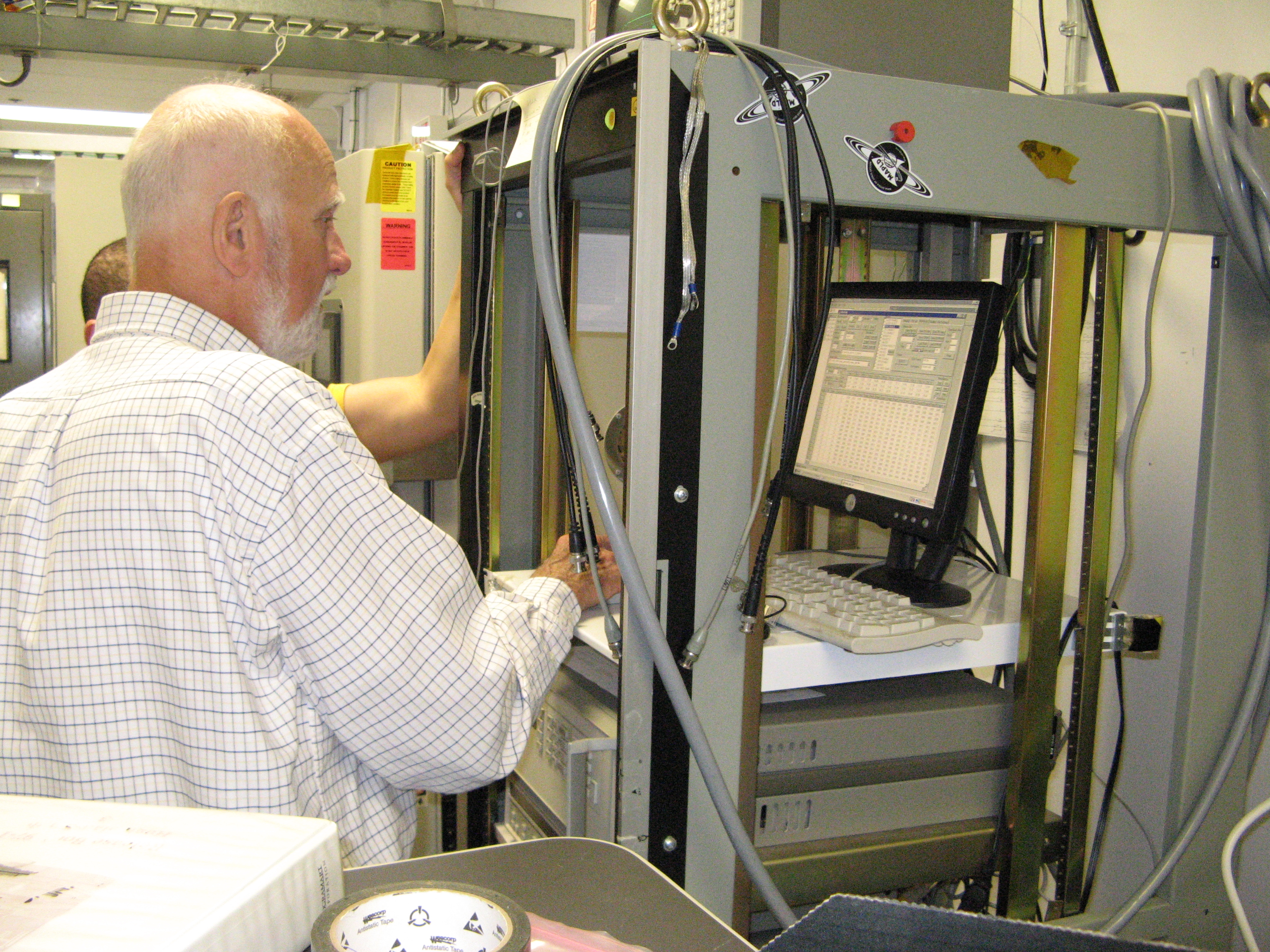
LOLA was inspired in part by the old Pioneer probes ... and we've dusted off some test equipment from that era! September 26, 2007.
Running Smalley3, October 19, 2007
FM1, Pre-delivery, August 22, 2007
Range Measurement Board
Command and Telemetry Board
FM Delivery, August 2007
More pictures of the 1553 "Rod Chip", February 16, 2006
Some reading ...
Unmanned Space Project Management: Surveyor and Lunar Orbiter1972
NASA SP-4901
Erasmus H. KlomanIntroduction (excerpt)
One of the valuable byproducts of the U S. space program is the body of knowledge concerning management of large complex development project activities. The brief span of years since the formation of NASA has witnessed the rapid evolution of a variety of systems and techniques for directing the combined efforts of thousands of individuals cooperating in closeknit programs in which Government, university, and private industry play mutually reinforcing roles. Many of the major learning experiences, such as those in the Apollo management system, have been applied to other activities within NASA. There has been only limited effort, however, to distill the generalized management experience gained in other NASA projects for application outside the space agency itself.Note: NASA commissioned the National Academy of Public Administration to undertake this study to look at its innovative management techniques on these complex technological projects.
Home - NASA
Office of Logic Design
Last Revised:
December 09, 2010
Web Grunt: Richard
Katz